“Sign-up and Receive Automatic Renewal Member Perks!”
We’ve all received promotions like this to reward automatic renewal. No longer do companies exclusively focus on the incentive of saving time on future purchases; they instead focus on tangible benefits to encourage anyone who might be on the fence about auto renewal.
For example, by signing up for the Entertainment Book’s automatic renewal program, I receive exclusive Renewal Members’ perks like:
$5 off your Renewal books every year
Free shipping on your Renewal books every year
Early delivery—15 full months to use each book
10% off additional books you buy as gifts or for yourself
Renewal Members-only exclusive offers and discounts
50% off additional Member Fine Dine Cards
New! FREE Companion mobile app — view your book on your phone
What if one of the associations I belong to was to send me a similar email, would I sign up for their automatic renewal program? What about you, would you sign up? What type of perks would entice the typical association member to choose to automatically renew their membership from year to year? How about:
$5 off the next year’s dues
Free shipping on your next order from the association’s bookstore
5% off the next Annual Conference registration fee
Admittance to a free webinar held exclusively for Renewal Members only
Do you have other ideas to add to this list? Does your association offer an automatic renewal program?
I love a good “list post.” You’ve probably seen them everywhere: Top 10 Ways to Simplify Your Life Before Breakfast, 5 Ways to Be a Superhero Every Day, or 7 Movies You Didn’t Know Are Based on a True Story. List posts get you to the information you need without a lot of fuss and then get you on to the rest of your day.
In honor of this perennial favorite, we present to you a roundup of the top list posts from the IMI blog!
We’ve all been there. You’re sitting in a group meeting nervously tapping your foot and wondering if you should speak up with your idea. Or, worse yet, the collective sigh as you asked a question left you wondering if you spoke out of turn.
How do you know if it’s the right time to share your idea?
Here are a few questions to ask yourself before speaking up in a meeting.
Should I Say Something?
Is the idea on topic and on task?
If it’s on topic, on task, and an appropriate time to speak up, go ahead and share!
If you plan to say, “This is off topic, but …” you should plan to bring up the idea later. You want your contributions help to achieve the goal of the meeting – that will always help you look good.
Does the concern or idea affect the entire group?
If you want to try a new process but it might affect others, such as cause them to receive emails about the change or affect how their normal procedures work, it’s definitely a team concern, so speak up!
If the question is only for your supervisor and doesn’t affect the rest of the team, it’s likely a personal question in disguise.
Can the question be answered quickly in an email?
Send an email unless it’s an FAQ others are concerned about, too.
Has someone else already expressed the concern?
Make sure that your question covers new territory or asks for clarification on a particular point. If you’re confused about details, it’s likely others are, too.
Does it require a long explanation?
If the idea can’t be explained simply, the idea probably isn’t fully developed. Refine your pitch to be brief and focused on the goal of the meeting.
Does it require sharing confidential information?
Never betray a confidence. You should rework your comment to include only appropriate information or don’t share it. Remember, loose lips sink ships.
Will it put a team member in a negative light?
Don’t throw your teammate under the proverbial bus – especially in a group meeting. Carefully craft your comments to be solutions focused before you share your idea. As always, a good rule of thumb is that it’s better to be safe than sorry.
Still unsure? During an appropriate time in the meeting, such as the Q&A at the end, ask, “Do we have time to cover [topic]?” Keep this request just as brief and simple as that. Be sure to wait for the leader to respond before you go any further.
Remember, the idea doesn’t have to “die” just because it isn’t shared in the meeting. Great ideas that are off-topic are still great ideas. Make a note of those sidebar, off-topic ideas and share them with the appropriate person after the meeting.
Often, it’s less about when you say something and more about how you say it. It helps to think about how you want people to perceive you. Do you want to be seen as being solutions oriented, a problem solver and a marvel of efficiency? Shape your questions and comments around those ideas.
Whether you share in the meeting or afterwards via email, make sure you pass along your innovative ideas. Your team needs your valuable perspective!
Looking for new and different inspiration for your associations? Check out a TED Talk.
If you haven’t heard of them yet, TED Talks are Technology, Entertainment, and Design presentations under the concept of “Ideas Worth Spreading.” (More on TED Talks here.)
Most of the Talks are about 20min long, which is the perfect length to view over lunch and refresh your mind for the rest of the day.
While TED Talks aren’t specifically about associations we think the concepts can provide inspiration for any organization.
Neglected the most important piece of information and needed to send a second email
Accidentally clicked “Reply All”
And wished you could undo it. This post is for you.
How to Unsend an Email … Sort Of.
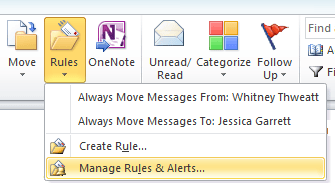
Using Rules in Outlook, you can set up “deferred delivery” of an email such that after you click “Send” your email will sit in the Outbox for a time before it actually sends.
During that time, if you suddenly realize you forgot the attachment, etc., you can re-open the email in your Outbox, make changes, and click Send again.
While this function won’t actually bring the email back after it has been delivered, it does give you a small window of time to fix a mistake.
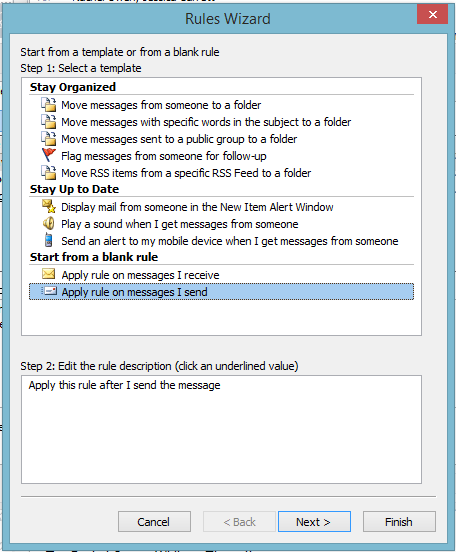
At the pop up, select “Apply rule on messages I send” > Click Next.
At the “Which condition(s) do you want to check?” screen, do not select anything. Click Next.
Click “Yes” when prompted to apply the rule to every message you send.
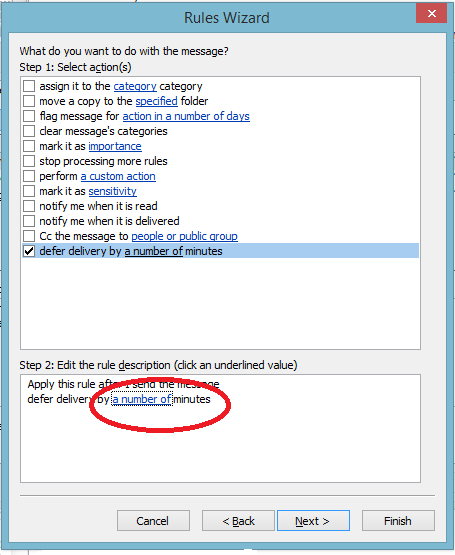
Select “Defer delivery by a number of minutes.” In the Step 2 box, click the “number of minutes” to specify how many minutes to defer delivery. Click Next. A one minute delay has served me well. If you find that one minute isn’t enough time you can always modify the rule to boost the delay to two minutes or more.
On the next screen, you can set up any exceptions to the rule here. If not, click Next.
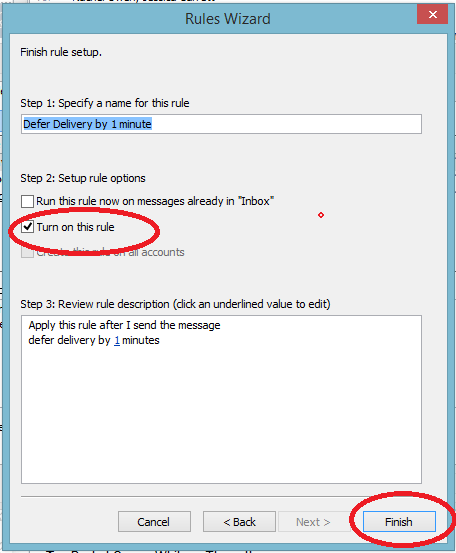
Name your rule, select “Turn on this rule” and click Finish! You will want to keep the name simple, such as “Defer delivery by 1 minute.”
If you don’t want to delay all of your emails, check out the first part of this post for how to delay a single email.
Do you have any other email tips? Please share in the comments below!
We at IMI were proud to send four staff members to this year’s ASAE Annual Meeting in Detroit, Mich. With such a large team in attendance, we were able to take advantage of a variety of sessions to get a good taste of what ASAE had to offer at this year’s conference.
These are the top speakers and sessions that our staff found to be dynamic, informative and memorable. Whether you are scoping out potential speakers for an upcoming conference or looking for educational resources, this post is for you.
Speaker: Jared D. Harris, faculty member at the University of Virginia’s Darden School of Business and a Senior Fellow at Darden’s Olsson Center for Applied Ethics
Comments: This was by far my favorite session out of all the sessions I have attended over the past eight ASAE Annual Meetings. If ASAE partners again with the Darden School of Business for future sessions I will be there! Workshop participants were presented with two real-life business situations which presented an opportunity for us to test our mastery of techniques and to refine our business judgment. This workshop definitely helped me improve my way of thinking about business situations.
Speakers: Glenn Tecker, ADHD, DsLx , Chairman and Co-CEO, Tecker International LLC; Andy Clarke , CAE, former President, League of American Bicyclists; Cynthia Mills, FASAE, CAE, CMC, CPC, CCRC , Founder, President & CEO, The Leaders Haven
Comments: I attended this session after finding one of Glenn Tecker’s books to be extremely helpful , so this session was a “must attend” on my list. I found the session to be interactive and had to chuckle at the two scenarios which were presented for consideration on how to navigate and how to prevent a similar scenario from happening.
Speakers: Tammy Barnes, Director, Operations State Advocacy, American Psychological Association; John Ganoe, CAE, Executive Director, Community Association Managers International Certification Board; Tracy King, MA, CAE, Principal & Founder, InspirEd, LLC; Jakub Konysz, MA, CAE, Manager, Strategic Global Initiatives, American Chemical Society; Conor McNulty, CAE, Executive Director, Oregon Dental Association; Mark Milroy, CAE, Vice President, Learning, ASAE; Stefanie Reeves, MA, CAE, Executive Director, Maryland Psychological Association; Erik Schonher, Vice President, Marketing General Incorporated; Catherine Wemette, CAE, Chief Goodness Officer, Good for the Soul; Beth Z. Ziesenis, Your Nerdy Best Friend
Comments: The IGNITE session was my favorite! It’s the learning format that’s fast, fun, and focused where each speaker gets 20 slides, auto-advancing every 15 seconds, for five minutes total. The concept is really cool, and it kept it interesting, fresh, and sometimes funny when the slides advanced before the speaker was ready. I wrote down lots of good quotes and quips from the session, but I think that the overarching theme of the session, “enlighten us, but make it quick”, was probably my favorite. I’m looking for ways to bring this into my meetings.
Reggie Henry, ASAE’s Chief information Officer spoke at a CEO Power Breakfast hosted by Fort Worth CVB. Reggie was a dynamic and engaging speaker. The focus of his session was how advances in technology are changing the way we work and live. Then he shared insights on how particular technology can be used to change the way associations provide content and services to member in order to remain relevant. This session was not one of the regularly scheduled ASAE events. However, if your membership profile has you listed as a CEO of your organization you should receive an invitation to the session directly from the Fort Worth CVB.
Jeff Hurt, EVP with Velvet Chainsaw Consulting led the session Strengthen Your Strategic Thinking Muscles To Become A Better Leader. Jeff tangled with a difficult subject – strategic thinking – to really focus on how thinking more strategically can help us become better leaders. In the process he distilled and defined strategic thinking and provided a plethora of engaging activities for the audience all in a 30 minute session.
Deedre Daniel, Director of Partnership Marketing with GEICO spoke again this year at ASAE. Last year I loved her dynamic and engaging session on LinkedIn. This year she not only provided her insights at a session on her own (Learn to Share or Your Bottom Line will get Spanked), she teamed up with some heavy hitters to present Selling to Association. Deedra is definitely a presenter to watch.
The Association Management Companies Institute just rolled out a report that spell$ big new$ for the a$$ociation management industry. Err… sorry, appears the “s” key on our keyboard is broken, but we’ll just replace it with a $ sign, which is exactly what the July 2015 report is about: more $$$ for associations managed by an AMC. (Learn more about what an AMC is here.)
Commissioned by AMCI, an independent researcher from Brigham Young University found that associations using AMCs have stronger financial performance than those that do not. In fact, the report found that “AMC-managed associations experience more than three times the growth in net assets and 31 percent more growth in net revenue, regardless of size and tax status” (here). The study surveyed more than 160 associations with budgets ranging from $500,000 to $7.5 million, which is a good indicator that the study’s results are applicable across associations of different types and sizes. This is huge news for an industry where many associations still shy away from AMCs because they fear the cost or lack of added value.
The research is in: Using an AMC can more than triple your assets. Check out more info on the research study here or see what IMI could bring to your association here.
Whether it’s a one hour webinar, a conference, or a certification program, professional development is an important investment of our time, resources and attention. How do you make sure you are getting the most out of your investment?
Team-Up
If you’re attending an event, find out if any colleagues plan to attend as well. For the 2015 ASAE Annual Meeting in Detroit, IMI sent four staff members which allowed us to take advantage of a variety of the concurrent sessions and maximize the information we learned. Going as a team also helps to alleviate that disappointment when you simply can’t make it to a session on your “wish list.” You can coordinate schedules to see if someone is able to sit in the session for you.
Debrief
Immediately following the event, get together with attendees and discuss the highlights. Talking through the information can really help to solidify concepts and flesh out ideas. Also, hearing how others experienced the event provides “fresh” eyes on what we experienced. Don’t forget to make a list of any action items that come up as part of the discussion. If you didn’t attend with colleagues, you can journal or write a blog post for a similar effect.
Here are just a few questions you can use to generate discussion:
What excited you?
What was helpful?
What needs further research?
What did you learn that you didn’t know before?
What did or didn’t work for you as an attendee?
How did the speaker make you feel?
What made the session engaging?
Would you attend next year?
What would you do differently?
Who did you meet?
Share
Make sure that you share the knowledge and ideas with the entire team – not just those who attended. IMI best practice is to share meeting notes and any resources with the entire team so that everyone can benefit. Get in the habit of taking good notes! If you take notes the old-fashioned way, like I do, type up the important concepts after the meeting. During a webinar, screenshots are helpful to capture visual resources and quickly summarize key points.
Apply
Applying the new information is the most crucial part. One thing I like to do is carve out a small block of time following the meeting to make the first steps on those action items or to schedule further time to research. Perhaps you need to redesign your Twitter header, set an appointment with your insurance agent, schedule a staff meeting to discuss a new process, or research a new association management system. Break any large tasks into smaller, manageable tasks. At next year’s conference you’ll be able to look back and see how far you’ve come.
Stay tuned for a list of our top ASAE sessions and more about what we learned. Do you have any tips for getting the most out of your professional development opportunities? Let us know in the comments!
These ideas are inspired by the session “Making an Impact with Your Membership Materials: What Works, What Doesn’t” at the ASAE Annual Meeting on August 10, 2014, presented byDenise Gavilan, Walter Kim, Theresa Kramer-Burgess and Cecilia Cortes-Earle.
Our members are bombarded by information every day from articles, TV and social media. Many people see more than 350 marketing messages per day. How do you make sure that your membership communications resonate with members and don’t get lost in the clutter?
Here are 9 quick tips to help your next message to members make an impact.
Keep it small and impactful. Choose the top points – no more than three.
Make it about the reader. Focus less on your association and more on the reader – their results, concerns and solutions.
Focus on benefits – not features. Need a refresher about the difference between features and benefits? Read this.
Always answer the question for the reader, “What do members value the organization for?”
Vary your methods of delivery, but always keep the message consistent and authentic across all channels.
Adapt your message to the target audience. A member who is new to the association may need different information than a seasoned member. Make sure you know who your target is and how to best reach them.
Collect and use your testimonials. For great tips on the best ways to use your testimonials check out this post.
Read the copy out loud to see if it flows. If it’s awkward to read aloud it will be awkward for your readers, too.
Every message needs a clear call to action. Always ask: 1) What do I want the reader to do? (Register by a specific date, contact their legislator, “Like” the Facebook page, etc.), and 2) How do I want them to do it? (click a link, contact a staff member, register in person, etc.)
As an association management professional, I find myself constantly wondering how to improve the association and member benefits. In an age of almost limitless free resources available online, associations are faced with the daily challenge to show value and relevance to both current and potential members. What are some strategies association professionals can take to address this challenge?
Overhaul the governance model and committee operations.
Empower the CEO and leverage staff expertise.
Precisely define your member market.
Rationalize programs and services and focus on those that have the maximum effect.
Build robust technology framework.
Not sure where to start? Here are five high impact ideas to implement in your association.
5 Tips for Keeping Your Association Relevant:
Members and volunteers face a work/personal life dilemma. “I don’t have time” really means “I have better things to do with my time.” Volunteers expect a return on investment of time so make sure you are offering some short-time volunteer opportunities as well as ones that are worthwhile to the volunteer.
The board should focus on potential and possibilities; staff on implementation. Ideally you should have a competency-based board made up of five or six people.
Specialization is key. Associations should focus on their strengths instead of trying to be all things to all members. Members will narrow their memberships to those with highest return on investment.
Concentrate on the products that deliver the most value. Unused services and unneeded programs have no value. Prune obsolete services and your message becomes simpler.
Every association function can be enhanced or performed via technology. Not only can automating some tasks free up staff time for other important member projects, it may also increase involvement. Find out what technologies and services your members are already using and integrate current member resources into those systems.