3 Things I Learned About Membership

Image Credit: Brandon Morgan

Beth Wallace, administrative manager

An association is nothing without their members; members need an association to reach their goals efficiently and effectively. Put the two together and you have a dynamic duo! After working in membership for almost a year with IMI, I have learned a few things.

1. Make Members Happy
While working with our Assistant Executive Director, who has many years of experience with membership, I have learned that caring for members and making sure they are happy is very important.

A few examples of what that practically would look like is, if our quarterly magazine didn’t arrive to their house for some reason, we make sure to re-send it again, just in case the postal service lost it. If a previous member didn’t renew due to major difficulties that arose during their membership year, it is a good idea to compensate them for another membership year. It is up to you to show the association values them as an individual member and to prove how valuable your association can be to them.

2. Retention, Recruitment, Engagement
Retention, recruitment, and engagement are the three words that establish the foundation of membership. Retention is getting members to return as member again the next year. We want to keep members coming back and sharing about the value of the association to non-members.

Recruiting members allows the association to grow and thrive off of more skills and talents to live out their mission and reach new goals. Whether it is through the testimony of current members or by providing incentives, such as free webinars, you need to draw people in to see what else you have to offer. Monthly tracking of your members by category type and where they are located are great ways of determining where you need to improve recruitment and how you can draw those members in.

Engaging members through the association benefits will circle back to retention. The more that members feel engaged and active in the association, the more likely they will renew when their membership expires. Some ways to inspire engagement:

– Start discussions on social media about current topics in the field
– Highlight membership benefits weekly/monthly as a reminder
– Conduct surveys to see what benefits interest your members the most

3. Growth & Change
Growth and change are two words that can either strike fear into the hearts or bring pure excitement to the minds of members. I admit that I can get stuck in my old ways and think they are the best and most efficient way of going about life. This can be the case for long standing members of an association, too. Change causes fear of the unknown and uncertainty of how things will work out. For new or potential members, change means more information or tools that are applicable to them.

During my time with this association, our new membership year in 2014 made a huge impact. We revamped the benefits and the look of our membership retention and recruitment pieces. New members and individuals were full of praise for the new “more professional” look. However, with new things comes some resistance. Some were hesitant to the new ideas coming about in the association. This is to be expected and is to be handled with care. When members resist changes, we have an excellent opportunity to reach out and build a relationship by sharing an explanation of why the association made these changes. I believe by responding that way, with care and transparency, we gained trust with our members.

Want to know more about association management? Contact us info@imiae.com to find out more about what IMI Association Executives can do for your organization.

Volunteers – At the Heart of Every Association

2015-4-14 Volunteers
Image Credit: Mayur Gala

Stevie Kernick, owner emeritus

Volunteers are at the heart of every association’s mission. It’s volunteers that serve on the Board of Directors and lead strategic initiatives. It’s volunteers that donate time to the committees that drive strategic plan deliverables. It’s frequently volunteers who deliver educational content to an association in the form of webinars, as conference session leaders and producing work products and papers. And it’svolunteer icon volunteers that provide support to both small and large staffs in high volume situations like annual conferences, workshops and seminars.

So how does an association ensure the continued commitment of volunteers? Some members will step up to volunteer with little or no enticement. Other members will never volunteer no matter what the incentive. And, then, there are the “other ones.”

Every association has a pool of untapped volunteers. They are the “other ones.” Let’s focus efforts on how to reach that audience of potential volunteers with so much to offer to the association.

There are some simple steps to take to keep volunteer opportunities in the forefront with all members.

  • Add a checkbox to indicate interest in volunteering on all collateral sent to or available for members – correspondence, membership renewal forms, membership applications, conference and event registrations
  • Place a link to volunteer opportunities on the homepage of your website
  • Devote a section of your website to providing information about volunteering
  • Utilize the association’s Facebook page, Twitter feed and other social media outlets to alert members about a need or when new volunteer opportunities are presented

Engage your members in a dialogue about the volunteer process when you are face-to-face at conferences or special events. Include this as a standing agenda item for the Annual Membership Meeting. In person is an ideal opportunity to promote the association’s activities to the membership and ask for their participation.

Never underestimate the power of the “ask.” Members who won’t reach out and volunteer on their own may willingly respond if an opportunity is presented to them in person. The one-on-one discussion also provides a chance to assess the member’s interests and strengths allowing you to match them with an ideal volunteer position. There are very few who, when asked, will say no.

Try to offer a variety of opportunities to provide volunteer support beyond the traditional committee appointments. A taskforce within a committee or an ad hoc taskforce are traditionally more short-lived than a committee appointment and allows new volunteers to experiment with a short-term project and then, hopefully, take on a more significant role.

Some members may not have the bandwidth to commit to a committee or a taskforce appointment but would willingly proofread newsletter articles or white paper drafts.

It’s important to think beyond the usual volunteer roles and consider different models with which to engage members in volunteer activities.

Remember that not every method will be effective for every organization or for every potential volunteer but with a bit of creativity you can increase the emotional buy-in and participation of your members in the important work of their association.

Want to know more about association management? Contact us info@imiae.com to find out more about what IMI Association Executives can do for your organization.

Governance: Foundation vs. Association

Image Credit: Bernadette Gatsby

By Whitney Bertram, operations manager 

These ideas are inspired by the session “Get Your Governance House in Order” at the ASAE Annual Meeting on August 10, 2014, presented by John Bartoletti, M.Ed.; Michael Butera; Eileen Johnson Esq.; and E. Paul Roetert, Ph.D.

Foundations

If you create a foundation, foundation board members need to be separate from association board members.

The board should be selected for expertise, such as expertise in fundraising, management, finance, public relation and a passion for the foundation mission.

Consider asking foundation board members to pay/raise a certain amount of money to sit on the board.

Association Boards

Association boards should refrain from being involved in operations, but instead be involved in a higher level of policy setting. Ideally, the day to day management of the association should be handled by staff with expertise and specialized training in providing administrative services to trade associations, professional societies and educational foundations.

For every “member benefit” proposed, ask if it is what the members want and if there is a return on investment. A “good idea” isn’t a good idea if it doesn’t connect with members and carry its own weight.

Reduce the size of the board. When an association has a large board, executive committees sometimes become “a board within a board.” Smaller boards are more nimble with decision making.

The board should not have to review and act on any and all governance. Committees should be established that have specific expertise. Watch for duplication of committee efforts and silos. Consider forming task forces instead of committees. Don’t forget, task forces have a beginning and end.

Conduct board orientation and training. Make sure training is held regularly to keep everyone sharp and each member of the board contributing. Ask board members to complete self-evaluation forms periodically. See BoardSource from ASAE for more information on board self-assessment for associations.

Do you have more questions about foundations or association boards? Ask us in the comments below!

Want to know more about association management? Contact us info@imiae.com to find out more about what IMI Association Executives can do for your organization.

Bridging the Gap: The Bully on the Board

2015-3-17 the bully on the board
Image Credit: Jared Erondu

Lee Campbell, Executive Director & Director of Conference

These ideas are inspired by the session “Tackling the Turbo Bully on Your Board” at the ASAE Annual Meeting on August 10, 2014, presented by Mark Alcorn, Sandra Giarde, and Jamie Notter.

We all have a pretty good idea of what a bully looks like on the playground, but what does it look like when you have a “bully” on the board?

A bully is not someone who simply asks questions or occasionally offers a “contrary” opinion. (It’s very valuable to have people on the board who have the courage to say “no!”) A board bully uses intimidation to silence ideas, ignores the bylaws and policies, is self-focused rather than keeping the needs of the association in mind, and undermines the board decisions.

So, what do you do when you have a bully on the board?

Help Win the Fight by Offering:

  • Compelling Vision
    • Make sure the board is very clear on the mission so it becomes obvious when a bully starts to take everyone off course.
  • Board Training
    • Make sure the board volunteers have a strong sense of their voice. Yearly board training is essential for old and new volunteers to be well aware of the bylaws, policies, chain of command, and their legal duties.
  • Mentors Assigned to New Volunteers
    • New volunteers will follow the old and experienced board members.

Tools For Your Toolbox:

  • Establish Policies
    • Make sure you have job descriptions, conflict of interest policies, and antitrust statements in place. Develop a sample policy of misconduct and how a member of the board of directors can be removed.
  • Pre-screening of Volunteers during Nomination Process
    • The nominating committee should identify bullying behaviors before acceptance to the board.
  • Resolution Skills
    • Ask the bully questions to understand why the behavior is happening.
    • Move towards the conflict to achieve greater understanding instead of skirting around the issue.
    • Early detection and intervention is essential so the issue doesn’t have a chance to grow. Keep behavior observable. Remind the bully about the impact of their behavior on the board and on the association.
  • Alert the board leaders responsible for discipline.

There are also legal considerations so be sure to keep documentation. Consult legal counsel and other experts such as HR advisers and risk managers.

Want to know more about association management? Contact us info@imiae.com to find out more about what IMI Association Executives can do for your organization.

21 Tips for Better Board Meetings

2015-3-10 21 Tips for Board Meetings
Image Credit: Timothy Muza

Linda Owens, President

One of the great things about working for an AMC (association management company) is the ability to draw from other association management professionals within the company. At IMI, we take advantage of this benefit by intentionally scheduling brainstorming meetings to share ideas across the different account teams.

The theme for one of our recent meetings was Board Meeting Tips, Questions and Concerns. I walked away with this list of 21 Board Meetings Tips:

Board Agendas & Packets

  1. Align the agenda with the strategic plan.
  2. Review the strategic plan and outstanding board deliverables at the beginning of meeting rather than the end.
  3. Include an ongoing and regularly updated Excel spreadsheet of deliverables (what needs to be done, who needs to do it and projected completion date) to be addressed at the end of each meeting.
  4. Combine all documents into an Adobe binder and then use the bookmarks on the side for easy navigation during the meeting. Note: some board members may prefer to have original Word, Excel, etc. documents instead so they can edit them throughout the board meeting.
  5. Consider adding supplemental documents to a central repository area such as Central Desktop instead of including them in the conference binder.
  6. Work with board members, staff, etc., to create issue papers and discussion guides before bringing an idea or recommendation to the board. An issue paper should provide background on the issue, a list of pros and cons to be considered along with a recommendation for the board’s consideration.

Minutes

  1. Create a cheat-sheet about when a motion is required and when it is not. This is especially helpful to share with new board members or can also be included in the board packet for easy reference throughout a meeting.
  2. Practice “documentation, not elaboration” when drafting minutes. Remember there are legal reasons for not including too much detail, so leave out the conversation and names.
  3. Use the line number feature in Word when drafting minutes for easier proofing and corrections.

Webinar vs. Teleconference Meetings

  1. Research the pros and cons of teleconferences vs. Webinars. More and more boards are moving away from teleconferences in favor of Webinar meetings as it allows everyone to view the agenda and any supporting documents.
  2. Consider recording the meeting and reviewing it later to take notes as it can be difficult to take notes and show the needed documents.

In-person Meetings

  1. Include a printed agenda packet and also project on the screen. This allows you to create an electronics-free zone so people aren’t distracted checking email, etc.
  2. Allot time at each in-person meeting for training/leadership exercises. Include video clips to highlight the “theme” of the exercise.
  3. Provide fidget toys to help meeting attendees relax, stay focused during long meetings, and think creatively.
  4. Encourage meeting attendees to turn their name tent on end to signal their desire to speak.
  5. Print the association’s mission statement on the back of name tent so it faces the board member.
  6. Include Roberts Rules cheat sheet at back of board binder which shows ways to move discussions along. Note: anyone on the board, not just the president, can help with this. Incorporate indicators such as holding up a red paper or other item to wrap up conversations when off topic.
  7. Use a time-keeper.
  8. Assign seats, strategically setting out board tents ahead of time, as needed.

Other

  1. Staff should excuse themselves from executive sessions whenever staff performance or the AMC’s contract is being discussed. Staff should plan to stay in all other executive sessions to take minutes unless asked by the board to leave. Note: it is generally a recognized practice within the association management industry for executive staff to stay in the meeting when the board moves to an executive session.
  2. Encourage a 48 hour discussion period during online voting to give participants from different parts of the world time to weigh in before a vote is taken.

Do you have any additional tips to add to the list? If so, please share in the comments below!

Want to know more about association management? Contact us info@imiae.com to find out more about what IMI Association Executives can do for your organization.

5 Ways to Save a Bad Day

Image Credit: Ewa Stepkowska

Rachel Owen, communications manager

It happens to all of us. Traffic from a terrible accident on the highway makes you late for an important meeting. You receive a harsh email out of the blue. A conference speaker cancels at the last minute and you’re left scrambling for a replacement. Or, if you’re like me, you release a project you spent weeks working on and then discover there’s a typo on the front page. Sometimes, if you’re really unlucky, it all happens on the same day.

What can you do to get back on track when your day is off the rails?

Take 5.

Take a break. Get a change of space for a change of perspective. Go breathe some fresh air. Grab a cup of coffee. Do what works best for you to untangle your brain from the issues in front of you for 5-10 minutes.

Get it off your chest.

If you enjoy journaling, write down your concerns on paper. If you’re a talker, find a private place, like your car, to call up a friend and spill some feelings. Text a friend. Whatever you do, be discreet. You don’t want a misunderstanding in the office to make a bad day even worse.

Work on the things you can control. Let the rest go.

Mistakes are frustrating but they can be really great opportunities to find the weaknesses in your system. Don’t be afraid to examine where the problems originated from and work out a way to avoid them in the future. It’s only a true “failure” if you don’t learn anything from it. But, don’t kick yourself over something that’s out of your control.

Remember the wins.

Be careful not to let frustrations overshadow the things that are going right today. Take a couple minutes to recognize your accomplishments and wins for the day. I have a “Thanks and Kudos” file where I save kind notes from clients and coworkers. When I’m feeling discouraged, I look back at those notes and see that there have been many, many high points in my journey. It’s a good feeling.

Make a recovery plan.

Missed a meeting or a deadline? Call the person to apologize and reschedule. Too many projects vying for your attention? Make a list of your tasks, prioritize them, and handle the most important tasks first. You may not be able to accomplish everything you hoped to do, but with a little strategizing you can make the best of the rest of your day.

How do you get back on track? Please share your tips in the comments below!

Want to know more about association management? Contact us info@imiae.com to find out more about what IMI Association Executives can do for your organization.

Top 10 Excel Tips and Shortcuts

Image Credit: Alejandro Escamilla

By Adrian Emerson, Association Accounting Specialist

Microsoft Excel is a very versatile program that is not just for crunching numbers. You can use it for multiple tasks, like making lists, drafting a report, and drawing charts and graphs. Excel can be the association staff member’s best friend; however, there are some time saving features of Excel that almost everyone forgets.

Here are my top 10 tips and shortcuts to help make using Excel 2007 and newer more efficient and easier to use.

  1. Personalize your Quick Access Toolbar! (you know that little bar at the very top right corner of your screen)

You can add preloaded and custom buttons to this string, like Quick Print or a custom sort feature.

  1. Time and Date Stamps.
    1. To populate a static time or date stamp of the current date or time:
      1. For the date use – “Ctrl” + semi-colon
      2. For the time use – “Ctrl” + “Shift” + colon
    2. To populate an automatically updating time or date stamp:
      1. For the date use the formula: “=today()”
      2. For the time use the formula: “=now()”
  1. Basic Rules of Lists and Reports.
    1. Some of the features in Excel will not work if the any of the following is in your data group; here are some basic rules to follow:
      1. Put the sheet title in as a header, and not in the spreadsheet
      2. Always include appropriate row and column headings
      3. Do not leave entire rows blank
      4. Do not leave entire columns blank
      5. Make sure to use the same data type in an entire column
  1. Navigating Cells In a Data Range.
    1. Pressing “Enter” moves up and down the cells in a column
    2. Pressing “Tab” moves left and right in a row
    3. If you select a range of cells, pressing “Enter” and “Tab” will only move between the selected cells
    4. To quickly select a data range, click the first cell hold “Shift” and click the end of the range. This will select all cells in between.
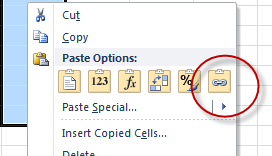
  1. Paste Link.

This feature copies and links the data from another sheet, and will update the next time you open the file.

ss 5

  1. Custom Sorting.
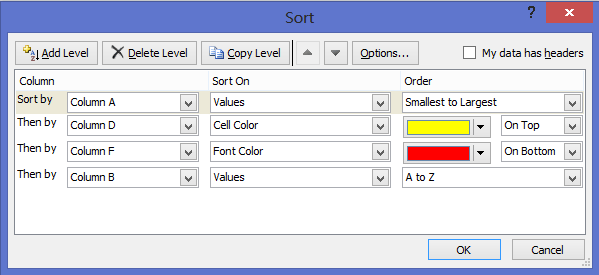
    1. The Multiple Sorting feature can sort data by multiple specified criteria at the same time. So, if you need a report to be sorted by letter in one column and by zip code in another this feature makes it really easy. ss 6
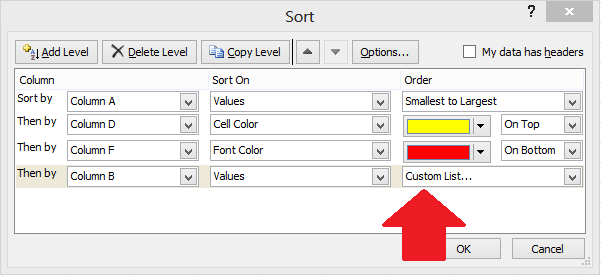
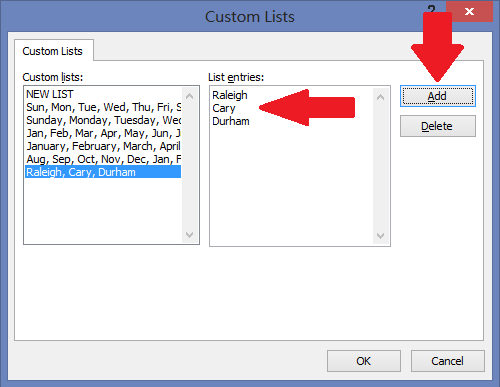
    2. Custom sorting listings can be set up for easier sorting, like by month, day of the week, or site location.ss 6b
      1. To create a new custom list click the “Add” Button.
      2. Then in the “List Entries” box type your new list.
      3. Then Click “OK”ss 6c
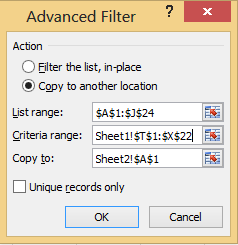
  1. Advanced Filter.

Allows you to set up more complicated queries and place a copy in a new area or sheet.

ss 7

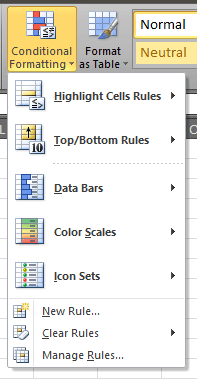
  1. Conditional Formatting.

This feature allows you to add selected formatting to specific data, like automatically changing the font color to red for any cell in the range that is below 100 or highlighting a cell if it is within a certain given range.ss 8

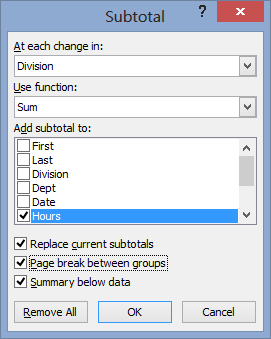
9. Subtotals.

This feature will automatically place subtotals and grand totals in a range of data per your specified groupings. NOTE: Make sure to sort your data before using this feature.

ss 9

10. Formulas.

NOTE: If you add new data at the beginning or at the end of a data range it will not automatically recalculate the formula.

A. VLOOKUP – “=VLookup(LookupValue,LookupTable,ColumnToReturn)”

This formula is probably one of the most widely used of the formulas second to AUTOSUM. The VLookup formula allows you to look up data from a range of data. You can use this formula to create a whole new table of data using data from other sheets and workbooks.

B. SUMIF – “=SUMIF(range, criterion, sumrange)

This formula will sum the data in a range that fit the selected criteria, like if you want to know the sum of only the sales for one location or one employee. However, this formula will only allow you to pick one criteria

C. SUMIFS – “=SUMIFS(sumrange, criteriarange1, criteria1, criteriarange2, criteria2, etc.)

This formula provides the same function as its sibling above, but will allow you to pick multiple criteria, like if you want to know the sum of sales for one employee at only one location or if you want to know the sum of only two employee’s sales at all locations.

What are your favorite Excel tips? Share in the comments below!

Want to know more about association management? Contact us info@imiae.com to find out more about what IMI Association Executives can do for your organization.

Creating Strong Leadership Teams

2015-2-10 Creating Strong Leadership Teams
Image Credit: Joshua Earle

Jalene Bowersmith, Executive Director

Tom Rath’s book Strengths Based Leadership builds on the basic principles discussed in the well-known book StrengthsFinder. Gallup has studied the strengths of well knowns leaders from around the world for over 30 years. Their research – condensed into this book – discusses what strengths the most successful leaders have and what great teams (their followers) need and expect from exceptional leaders.

Many of us have read books about leadership and the five, seven or 10 characteristics of successful leaders. However, Rath points out that the fastest way to fail at leadership is to lead by imitation. In Gallup’s studies there is only one characteristic that all strong leaders share; successful leaders know their strengths and limitations. They use their strength like “a carpenter uses his tools.” A leader cannot be all things to all people. However, by knowing their strengths and limitations strong leaders are able to focus on what they do well and surround themselves with individuals strong in the areas where they are weak, creating a strong supportive team.

Building strong teams takes time and energy. Getting individuals with diverse, yet complementary strengths on a team is a good start. But that is not enough to make a team successful. Leaders must continually invest in each person’s strengths and build better relationships among the group. What are the signs of a strong teams? Gallup’s research shows that strong, successful teams share the following characteristics:

Focus on results – Instead of becoming more isolated during difficulty times strong teams come together. They gain strength from cohesion. They can argue, but in the end they know they are all working towards the same goal.

Prioritize what’s best for the organization – They consistently put what is best for the organization ahead of their egos. Once a decision is made the team rallies to help one another be successful.

Commitment to personal and work life – They bring the same level of energy to their family and social lives as they do to their companies. They feel their lives are balanced.

Embrace diversity –   A team that embraces diversity of age, gender, race, and strengths brings balance to the whole. Teams that are engaged view individuals through the lens of their strengths, thereby eliminating superficial barriers.

Magnets for talent – Everyone wants to be on a strong team. Your star players see that they can make an impact and demonstrate their strengths.

Effective leaders bring together a broad group of people to carry out an organization’s goals. In order to understand why leaders are successful it is not only important to understand what a strong team looks like, but why people follow that leader. From 2005-2008 Gallup polled 10,000 followers (average people). They determined that there are four things that followers look for in a good leader:

Trust – Once a trusting relationship is established people can complete projects in the fraction of the time and become a high performing team.

Compassion – Leaders that care about their team project a more positive energy. People want to follow leaders that exude a positive bias.

Stability – Transparency is the best way to quickly create a feeling of stability in a group.

Hope – Followers want hope for the future and guidance on how to get there. Knowing that things can and will be better in the future is an excellent motivator.

Knowing the characteristics of strong teams and understanding what teams look for in successful leaders provides us with the tools for better leadership and building more successful teams. Whether the team you work with is association or AMC staff, a volunteer board or committee members, knowing what makes a strong team and what they are looking for in a leader is the first step to creating strong leadership teams.

For more information on StrengthsFinder and strengths-based leadership check out this post.

Want to know more about association management? Contact us info@imiae.com to find out more about what IMI Association Executives can do for your organization.

The Value of a Handwritten Thank You Note

Image Credit: Alejandro Escamilla

Whitney Bertram, Operations Manager


A lot of what I do daily, I learned from my mom. Make the bed. Say “please.” Floss. Turn off the light when you leave the room. Walk the dog. And always send a thank you note.

Growing up, my siblings and I always had to send a handwritten thank you note after receiving a gift. We had a deadline of one week.

To this day, I still receive a thank you note from each of my sisters and brother after Christmas and their birthdays, even if they thanked me in person.

In this electronic age, it’s easy to shoot off a quick email or post on someone’s Facebook wall. Sending handwritten notes is becoming such a lost art that I’ve even received “thank you for your thank you note” notes. People genuinely appreciate the simple act of a handwritten thank you. I often display the ones I receive on my desk or pin them to my bulletin board as opposed to a quick “delete.”

Think about the feeling you get when you check your mailbox and you see your address written in ink. Mail (not including bills, credit card offers or junk) seems to be a thing of the past. A handwritten note can make someone’s day.

Penning a quick note of appreciation to a vendor, sponsor or volunteer takes only a few minutes but will let the recipient know you value their time, effort and support.

Send a thank you email, express your gratitude in person, but never underestimate the sentiment of the handwritten note.


Want to know more about association management? Contact us info@imiae.com to find out more about what IMI Association Executives can do for your organization.
IMI: All About Animals

Image Credit: André Spieker

By Adrian Emerson, Association Accounting Specialist and 2014 Chair of the IMI Association Executives Fun Committee


In a previous post, I discussed how IMI wanted to start a new charity program and the process I followed to develop a program for our team. Here’s an update on the second and third quarter collections.

For our second quarter project, we collected donations for someone in our office who was experiencing hardship. We purchased a large basket and filled it with all kinds of goodies, like gift cards and other items this person needed. She was thrilled with the outpouring and we were all happy to do it. These kinds of collections can be tough to coordinate but are just as important as the bigger charity programs already out there. We at IMI are proud to say that we will help our employees and their families when we can.

During our third quarter we chose to collect donations for the SPCA of Wake County. The SPCA of Wake County, located in Raleigh, N.C., was founded in 1967, and has rehomed thousands of animals during that time. Their mission statement is: “To protect, shelter, and promote the adoption of homeless animals; to provide education about responsible pet ownership and to reduce pet overpopulation through spay/neuter programs.” The organization operates solely on donations, and does not receive government funding. For more information, visit the SPCA of Wake County website. For this charity effort, I built a custom website at a third-party website called Razoo.com. Razoo.com allows you to set up a website to collect donations for a small fee. They are connected with thousands of charities and can even help to set up a new fundraiser. We collected donations in August and September for a total of $225.

Now, I am gearing up for our fourth quarter charity project, which will be to collect donations for Backpack Buddies, a program coordinated by the Inter-Faith Food Shuttle, located in Raleigh. This collection will be our final community service project for the year.

In 2014, IMI collected donations for the American Heart Association for Women, a co-worker, the SPCA of Wake County, and Backpack Buddies of Raleigh. I am proud of what our group was able to accomplish. We plan to do something similar next year with different charities. I urge you to set up a collection in your office, even if it is just placing a tip jar in an office common room or organizing a group to participate in a marathon. Every little bit helps, and brings happiness to those in need.


Want to know more about association management? Contact us info@imiae.com to find out more about what IMI Association Executives can do for your organization.