
5 Ways to Save a Bad Day

Image Credit: Ewa Stepkowska

Rachel Owen, communications manager

It happens to all of us. Traffic from a terrible accident on the highway makes you late for an important meeting. You receive a harsh email out of the blue. A conference speaker cancels at the last minute and you’re left scrambling for a replacement. Or, if you’re like me, you release a project you spent weeks working on and then discover there’s a typo on the front page. Sometimes, if you’re really unlucky, it all happens on the same day.

What can you do to get back on track when your day is off the rails?

Take 5.

Take a break. Get a change of space for a change of perspective. Go breathe some fresh air. Grab a cup of coffee. Do what works best for you to untangle your brain from the issues in front of you for 5-10 minutes.

Get it off your chest.

If you enjoy journaling, write down your concerns on paper. If you’re a talker, find a private place, like your car, to call up a friend and spill some feelings. Text a friend. Whatever you do, be discreet. You don’t want a misunderstanding in the office to make a bad day even worse.

Work on the things you can control. Let the rest go.

Mistakes are frustrating but they can be really great opportunities to find the weaknesses in your system. Don’t be afraid to examine where the problems originated from and work out a way to avoid them in the future. It’s only a true “failure” if you don’t learn anything from it. But, don’t kick yourself over something that’s out of your control.

Remember the wins.

Be careful not to let frustrations overshadow the things that are going right today. Take a couple minutes to recognize your accomplishments and wins for the day. I have a “Thanks and Kudos” file where I save kind notes from clients and coworkers. When I’m feeling discouraged, I look back at those notes and see that there have been many, many high points in my journey. It’s a good feeling.

Make a recovery plan.

Missed a meeting or a deadline? Call the person to apologize and reschedule. Too many projects vying for your attention? Make a list of your tasks, prioritize them, and handle the most important tasks first. You may not be able to accomplish everything you hoped to do, but with a little strategizing you can make the best of the rest of your day.

How do you get back on track? Please share your tips in the comments below!

Want to know more about association management? Contact us info@imiae.com to find out more about what IMI Association Executives can do for your organization.

Tips for Effective Lobbying

Image Credit: Erik Heddema

By Whitney Bertram, operations manager

I’ve scheduled a meeting with my legislator… Now what?

Come to the meeting prepared. You will have only a short time to talk to your legislator because of the many constituents who want to see him or her about issues or problems. Organize your meeting by following the tips below:

  • Take a letter or fact sheet to the meeting to leave with the legislator.
  • Practice in advance. Anticipate answering questions about the issue.
  • Be yourself. Most legislators are good listeners so they want to hear your perspective on the issue.
  • Treat your legislator as you’d want to be treated; be respectful and professional.
  • Never threaten or brag on your campaigning or contributions when talking about issues.
  • Thank your legislators for their support, time and serving in public office.
  • Send a thank you note after the meeting.
  • Report back to your association to let them know how the meeting went.

If I can’t meet in person, will a phone call work?

Yes, phone calls can be effective if you follow these steps:

  • Write down key points before you call.
  • Practice in advance.
  • If you are a constituent of the legislator, be sure to mention it.
  • Ask for a report on how the legislator stands/voted on the issue.
  • Be brief. Keep your call under five minutes.
  • Be respectful and professional.
  • Follow up with a written thank you note restating your position.
  • Report results to your association.

Should I send a letter?

There is power in numbers when it comes to lobbying. Imagine the impact if every person in the state in your industry was to generate a new letter to legislators each week about pending legislation or issues. Letters to representatives should follow these guidelines:

  • Always type your letter. While handwritten is more personal, the letter should be very easy to read.
  • Use your company or association letterhead so the legislator knows who you are and what organization you represent.
  • Keep your letter to one page. Include fact sheets or other information on additional pages.
  • Include your name and address.
  • If you are a constituent, include that information.
  • Outline your view on the issue/legislation.
  • Request that the legislator support the legislation.

How can I find out who my legislators are and how can I obtain their mailing and email addresses?

Visit www.votesmart.org and enter your nine digit zip code to determine who your representatives are.

Do you have tips for connecting with legislators or a success story to share? Tell us in the comments!

Want to know more about association management? Contact us info@imiae.com to find out more about what IMI Association Executives can do for your organization.

Top 10 Excel Tips and Shortcuts

Image Credit: Alejandro Escamilla

By Adrian Emerson, Association Accounting Specialist

Microsoft Excel is a very versatile program that is not just for crunching numbers. You can use it for multiple tasks, like making lists, drafting a report, and drawing charts and graphs. Excel can be the association staff member’s best friend; however, there are some time saving features of Excel that almost everyone forgets.

Here are my top 10 tips and shortcuts to help make using Excel 2007 and newer more efficient and easier to use.

  1. Personalize your Quick Access Toolbar! (you know that little bar at the very top right corner of your screen)

You can add preloaded and custom buttons to this string, like Quick Print or a custom sort feature.

  1. Time and Date Stamps.
    1. To populate a static time or date stamp of the current date or time:
      1. For the date use – “Ctrl” + semi-colon
      2. For the time use – “Ctrl” + “Shift” + colon
    2. To populate an automatically updating time or date stamp:
      1. For the date use the formula: “=today()”
      2. For the time use the formula: “=now()”
  1. Basic Rules of Lists and Reports.
    1. Some of the features in Excel will not work if the any of the following is in your data group; here are some basic rules to follow:
      1. Put the sheet title in as a header, and not in the spreadsheet
      2. Always include appropriate row and column headings
      3. Do not leave entire rows blank
      4. Do not leave entire columns blank
      5. Make sure to use the same data type in an entire column
  1. Navigating Cells In a Data Range.
    1. Pressing “Enter” moves up and down the cells in a column
    2. Pressing “Tab” moves left and right in a row
    3. If you select a range of cells, pressing “Enter” and “Tab” will only move between the selected cells
    4. To quickly select a data range, click the first cell hold “Shift” and click the end of the range. This will select all cells in between.
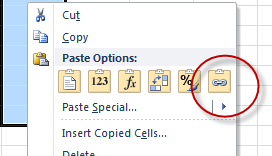
  1. Paste Link.

This feature copies and links the data from another sheet, and will update the next time you open the file.

ss 5

  1. Custom Sorting.
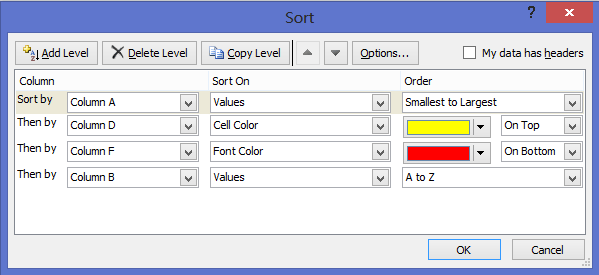
    1. The Multiple Sorting feature can sort data by multiple specified criteria at the same time. So, if you need a report to be sorted by letter in one column and by zip code in another this feature makes it really easy. ss 6
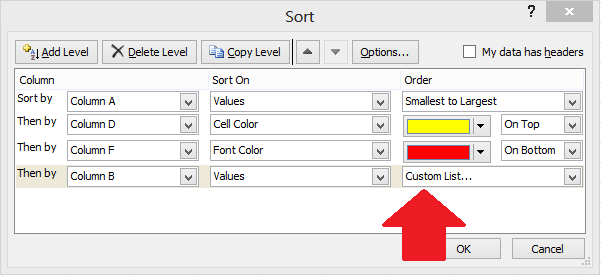
    2. Custom sorting listings can be set up for easier sorting, like by month, day of the week, or site location.ss 6b
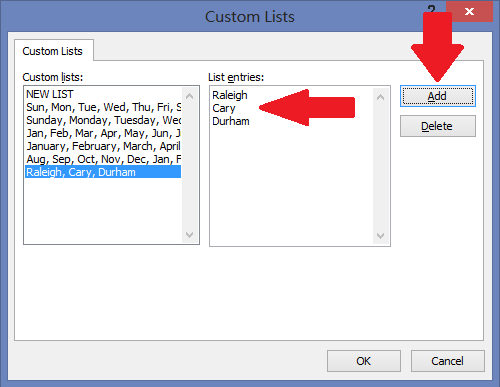
      1. To create a new custom list click the “Add” Button.
      2. Then in the “List Entries” box type your new list.
      3. Then Click “OK”ss 6c
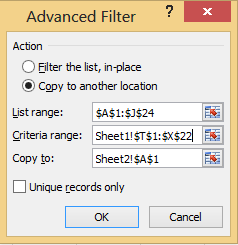
  1. Advanced Filter.

Allows you to set up more complicated queries and place a copy in a new area or sheet.

ss 7

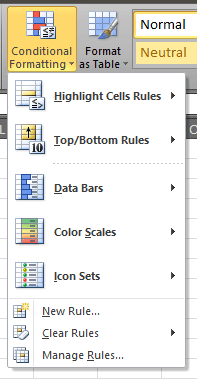
  1. Conditional Formatting.

This feature allows you to add selected formatting to specific data, like automatically changing the font color to red for any cell in the range that is below 100 or highlighting a cell if it is within a certain given range.ss 8

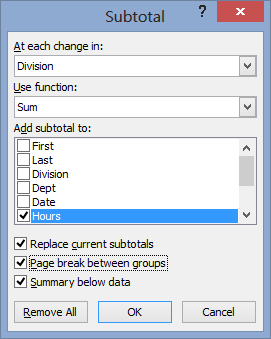
9. Subtotals.

This feature will automatically place subtotals and grand totals in a range of data per your specified groupings. NOTE: Make sure to sort your data before using this feature.

ss 9

10. Formulas.

NOTE: If you add new data at the beginning or at the end of a data range it will not automatically recalculate the formula.

A. VLOOKUP – “=VLookup(LookupValue,LookupTable,ColumnToReturn)”

This formula is probably one of the most widely used of the formulas second to AUTOSUM. The VLookup formula allows you to look up data from a range of data. You can use this formula to create a whole new table of data using data from other sheets and workbooks.

B. SUMIF – “=SUMIF(range, criterion, sumrange)

This formula will sum the data in a range that fit the selected criteria, like if you want to know the sum of only the sales for one location or one employee. However, this formula will only allow you to pick one criteria

C. SUMIFS – “=SUMIFS(sumrange, criteriarange1, criteria1, criteriarange2, criteria2, etc.)

This formula provides the same function as its sibling above, but will allow you to pick multiple criteria, like if you want to know the sum of sales for one employee at only one location or if you want to know the sum of only two employee’s sales at all locations.

What are your favorite Excel tips? Share in the comments below!

Want to know more about association management? Contact us info@imiae.com to find out more about what IMI Association Executives can do for your organization.
Creating Strong Leadership Teams

2015-2-10 Creating Strong Leadership Teams
Image Credit: Joshua Earle

Jalene Bowersmith, Executive Director

Tom Rath’s book Strengths Based Leadership builds on the basic principles discussed in the well-known book StrengthsFinder. Gallup has studied the strengths of well knowns leaders from around the world for over 30 years. Their research – condensed into this book – discusses what strengths the most successful leaders have and what great teams (their followers) need and expect from exceptional leaders.

Many of us have read books about leadership and the five, seven or 10 characteristics of successful leaders. However, Rath points out that the fastest way to fail at leadership is to lead by imitation. In Gallup’s studies there is only one characteristic that all strong leaders share; successful leaders know their strengths and limitations. They use their strength like “a carpenter uses his tools.” A leader cannot be all things to all people. However, by knowing their strengths and limitations strong leaders are able to focus on what they do well and surround themselves with individuals strong in the areas where they are weak, creating a strong supportive team.

Building strong teams takes time and energy. Getting individuals with diverse, yet complementary strengths on a team is a good start. But that is not enough to make a team successful. Leaders must continually invest in each person’s strengths and build better relationships among the group. What are the signs of a strong teams? Gallup’s research shows that strong, successful teams share the following characteristics:

Focus on results – Instead of becoming more isolated during difficulty times strong teams come together. They gain strength from cohesion. They can argue, but in the end they know they are all working towards the same goal.

Prioritize what’s best for the organization – They consistently put what is best for the organization ahead of their egos. Once a decision is made the team rallies to help one another be successful.

Commitment to personal and work life – They bring the same level of energy to their family and social lives as they do to their companies. They feel their lives are balanced.

Embrace diversity –   A team that embraces diversity of age, gender, race, and strengths brings balance to the whole. Teams that are engaged view individuals through the lens of their strengths, thereby eliminating superficial barriers.

Magnets for talent – Everyone wants to be on a strong team. Your star players see that they can make an impact and demonstrate their strengths.

Effective leaders bring together a broad group of people to carry out an organization’s goals. In order to understand why leaders are successful it is not only important to understand what a strong team looks like, but why people follow that leader. From 2005-2008 Gallup polled 10,000 followers (average people). They determined that there are four things that followers look for in a good leader:

Trust – Once a trusting relationship is established people can complete projects in the fraction of the time and become a high performing team.

Compassion – Leaders that care about their team project a more positive energy. People want to follow leaders that exude a positive bias.

Stability – Transparency is the best way to quickly create a feeling of stability in a group.

Hope – Followers want hope for the future and guidance on how to get there. Knowing that things can and will be better in the future is an excellent motivator.

Knowing the characteristics of strong teams and understanding what teams look for in successful leaders provides us with the tools for better leadership and building more successful teams. Whether the team you work with is association or AMC staff, a volunteer board or committee members, knowing what makes a strong team and what they are looking for in a leader is the first step to creating strong leadership teams.

For more information on StrengthsFinder and strengths-based leadership check out this post.

Want to know more about association management? Contact us info@imiae.com to find out more about what IMI Association Executives can do for your organization.
Tips for Working from Home

2015-2-3 Tips for Working from Home
Image Credit: Aleksi Tappura

Whitney Bertram, Operations Manager

More and more companies are offering employees the ability to work remotely, whether it is full-time, a few days a week, or just as needed. The technology available, such as call forwarding and remote access software, allows this process to be fairly seamless.

Anyone who works from home will probably agree that it has its benefits as well as its drawbacks. As a full-time remote employee, I have found the following tips to be helpful:

  • Set regular office hours. Maintain defined work hours and don’t accept phone calls or respond to emails outside of those hours. Set boundaries between work and personal life. Don’t allow work to consume your life.
  • Designate a workspace. Dedicate an area for working so that you feel as if you are “at work” when you enter that space.
  • Utilize a project management system to track status of tasks. I use Basecamp which allows each person on my client team to update the progress they’ve made on various tasks. This ensures nothing falls between the cracks.
  • Get up and move. Take breaks. Go for a walk. Play fetch with the dog. Schedule breaks to maintain your sanity and improve focus when you are working.
  • Schedule routine meetings with your team. I meet with my team every Monday morning. Working from home doesn’t allow me the convenience of stopping by someone’s office to touch base. Establishing set check-in times helps to keep the lines of communication open.
  • Talk to people. Pick up the phone to touch base with a co-worker. Meet a friend for lunch. Work for an afternoon at a coffee shop.
  • Stock your home office. Keep tools that will help you get your job done. Make sure you have pens, paper, ink and anything else needed. I have an all-in-one printer/scanner/copier that allows me to be more efficient. I don’t have to head to FedEx every time I need to return a signed contract.

Lastly, the common work from home tip I’ve ignored:

  • Get dressed. I have found I can work just as effectively and efficiently in yoga pants as I can in a skirt and heels. Find what works for you and supports your needs.

Want to know more about association management? Contact us info@imiae.com to find out more about what IMI Association Executives can do for your organization.
Professional Development: For Associations and AMCs (part 2)

Image Credit: S. Charles

Jadine Sturgill, administrative manager

This is the second in a 2-part series on professional development based on a recent Association Chat (#assnchat). Click here to read part 1.

Read below for more helpful thoughts about professional development from the IMI staff.

Q6. What are some good examples of professional development that you’ve seen associations provide?

  • Many organizations offer professional development via seminars, workshops, publications, and break-out sessions at conferences, online courses, case studies, white papers, journals, and information on their website shared only with members. They also keep members up to date on industry trends and how to deal with them.
  • There are numerous avenues of professional development offered to the members: free monthly educational webinars, educational tracks at the two annual conferences, an onsite Webinar Library, and individual certifications. The committees are dedicated to providing best practices resources and white papers. The website is continually being updated with member advisories, legislative alerts and headlines that affect the members’ industry. The weekly newsletter and bi-monthly magazine provide continual information from industry experts both nationally and globally located. Surveys are created and distributed to get member feedback for further development and improvement of best practices. A strategic planning meeting with the board of directors and executive director occurs annually to evaluate the progress and to set goals for the association for the following year.
  • Webinars are very effective – they can be provided at a low cost and members can participate from their offices.

Q7. How are you investing in your own professional development this year?

  • I try to attend at least one free, online webinar a month on a topic of interest to me; such as Tracking Social Media Success, or Five Things Your Members Want from Their Association Website. I like to read articles on what is trending and books. I was fortunate to attend the ASAE conference this year and I like to hear what my colleges are learning and share with them so we can all benefit.
  • I make every effort to attend ASAE’s Annual Meeting & Exposition and AMCI’s AMCs Engaged meeting. In addition to these two meetings, I am also an avid reader and subscribe to quite a few ListServs and I’m a social media junkie who follows hundreds of folks within the association management industry.
  • I set aside a small block of time each week and a larger block of time each month specifically for professional development. It’s an appointment I make to better myself – and therefore bring my best to my associations.
  • Being a member of AENC provides me with educational webinars and articles on a weekly basis. I am also committed to reading a number of industry-related books and considering taking some courses this year that will improve some of my computer skills and organization abilities.
  • I plan to continue attending events and webinars that help me make progress toward my goal of earning my CAE.


We hope you enjoyed IMI’s in-house #assnchat. If you haven’t tried #assnchat on Twitter, give it a try! You may find answers to questions you didn’t even know you had.

Want to know more about association management? Contact us info@imiae.com to find out more about what IMI Association Executives can do for your organization.
Professional Development: For Associations and AMCs (part 1)

Image Credit: S. Charles

Jadine Sturgill, administrative manager

This is part one of a 2-part series on professional development based on a recent Association Chat (#assnchat).
At IMI we continue to advance our skill through professional development opportunities to be able to better serve our clients. When KiKi L’Italien hosted an Association Chat (#assnchat) on Twitter on September 23, 2014, about professional development, it was a natural progression for the IMI staff to discuss these questions together.


Q1. How important is professional development to your members and do they see it as part of your association’s role to provide it?

  • Professional development is key to our members; it is important that they stay up to date with the latest developments in their field. They do look to our associations to provide professional development more and more.
  • Review the results of any survey asking why people join associations and typically you will find “education and professional development” among one of the top four answers, so I would say it is extremely important to our members and they do expect the association to provide outlets for continuing their education. Also, a lot of our members work in a profession which requires continued testing and education to maintain their license and/or credentials. The opportunity to earn those credits and learn through a professional organization is one of the most important reasons to join an association.
  • Our members see professional development as an important part of staying relevant in our quickly changing world – and they look to the association as a great resource for that education.
  • The association is highly committed in providing programs aimed at empowering members to better serve their clients as well as teaching excellence within its industry; this is part of their mission statement.
  • The association offers many professional development opportunities to members, including individual certifications, company accreditations and monthly webinars. Many members take advantage of the offerings.

Q4. What are your own expectations on professional development? What are you looking for?

  • Professional development is key to staying current and up to speed in a world that moves so quickly. I personally like to learn about processes and programs that will assist with strategic and operations of the organization and personal leadership topics.
  • I look for professional development opportunities which have a return on investment; opportunities which help me to be competent in my profession, which help me to stay relevant and up to date and more effective. The pace of change is probably faster than it’s ever been – and if you stand still you will get left behind.
  • When I look for professional development resources, I look from a variety of angles. Can I add a new skill set? Can I go to the next level in a skill I already have? What is the information I need to make sure I am at my best for my associations?
  • My belief is that one should never stop learning. I am always on the lookout for ways to improve my own abilities and knowledge in regard to my position here at IMI, including, webinars, books, courses and articles offered by AENC or similar organizations that directly affect my job responsibilities. I also enjoy learning from my colleagues here at IMI; we enjoy sharing information.
  • I attend professional development conferences and webinars throughout the year to expand on my knowledge base. I always enjoy learning about the latest topics.

 “At IMI we provide an education budget and encourage each staff person to pursue professional development opportunities because we recognize it is good for employee retention and staff morale, it improves efficiency and productivity, re-energizes staff and overall helps us to remain relevant as an association management company. In general, we see professional development as an investment, not an expense.”                  

-Linda Owens, president of IMI


Want to know more about association management? Contact us info@imiae.com to find out more about what IMI Association Executives can do for your organization.
Incorporating Content Marketing on Your Association Website

Image Credit: Steven Lewis

By Jalene Bowersmith, Executive Director

Based on 4 Trends Reinventing Association Websites presented by Ray van Hilts, Director, Client Strategy and Marketing, Vanguard Technology

As content marketing becomes more and more popular, associations are uniquely posed to promote the extensive amount of content they have created over the years. Content marketing encompasses the sharing of content to drive profitability and improve brand loyalty, while attracting and engaging members and potential members.

There are two basic types of content an association can market: formal and informal.

Informal – Social Media, Micro Videos, Blog Posts

Formal – Fact Sheets, News Articles, Features, Emails, Webinars, White Papers, Evergreen Content

Associations tend to have a lot of formal content. One way to jump-start the content marketing process and leverage formal content quickly is to perform a content audit. Determine what content the organization has and where it is located. Then determine the best place for that content to live. If the organization is planning to share most of the content with members and non-members, creating a library connected to the association website can become a convenient way to archive, tag and potentially repurpose content.

During the content audit consider what content is relevant today. Evergreen content may be the basis for a best practices library or web page on your site. Fact sheets or checklists may assist a particular category of member with their processes and be featured on a blog, or given new life in an article. There are many ways an organization can repurpose content; videos, educational opportunities, newsletters and articles are just a few options.

Now that you know what formal content you have, what is relevant, and how to repurpose it, think about the best audience for marketing that content. Determine the best way to share specific content and who you want to share it with. Is this content for members only, or will it help the organization’s profile to share it with the public? Should members pay extra to access the content (such as an educational webinar), or is it included with their membership fee. Asking these questions will help you determine where the content should live and how valuable it is to the organization, members and the public. In order to have a successful content marketing campaign it is important to think about content as having value and being marketable. Keep the following Content Marketer’s Manifesto tips in mind:

#1 I am a Marketer. If you are creating content, you are engaged in marketing.

#2 I hold the hottest tool for retention – Content. Relevant content is the best way to create value for members.

#3 My content is aligned with the organization’s goals. I create content that achieves my organization’s goals.

#4 I am in the influencing behavior game. My purpose is to provide value through content to influence and drive behavior.

#5 I have an ongoing dialogue. Content topics are driven by ongoing discussion and listening to member’s needs.

By shifting your thinking and seeing content as a marketing tool to reach potential members and engage longtime members, the organization can begin to develop a structure and process for sharing content across many different platforms.

Want to know more about association management? Contact us info@imiae.com to find out more about what IMI Association Executives can do for your organization.
The Value of a Handwritten Thank You Note

Image Credit: Alejandro Escamilla

Whitney Bertram, Operations Manager


A lot of what I do daily, I learned from my mom. Make the bed. Say “please.” Floss. Turn off the light when you leave the room. Walk the dog. And always send a thank you note.

Growing up, my siblings and I always had to send a handwritten thank you note after receiving a gift. We had a deadline of one week.

To this day, I still receive a thank you note from each of my sisters and brother after Christmas and their birthdays, even if they thanked me in person.

In this electronic age, it’s easy to shoot off a quick email or post on someone’s Facebook wall. Sending handwritten notes is becoming such a lost art that I’ve even received “thank you for your thank you note” notes. People genuinely appreciate the simple act of a handwritten thank you. I often display the ones I receive on my desk or pin them to my bulletin board as opposed to a quick “delete.”

Think about the feeling you get when you check your mailbox and you see your address written in ink. Mail (not including bills, credit card offers or junk) seems to be a thing of the past. A handwritten note can make someone’s day.

Penning a quick note of appreciation to a vendor, sponsor or volunteer takes only a few minutes but will let the recipient know you value their time, effort and support.

Send a thank you email, express your gratitude in person, but never underestimate the sentiment of the handwritten note.


Want to know more about association management? Contact us info@imiae.com to find out more about what IMI Association Executives can do for your organization.
Out of Office Best Practices

Image Credit: Sonja Langford

By Rachel Owen, Communications Manager

We are headed full swing into the holiday season when many people will be out of the office. Do you know what the best practices are for when you are out of the office?

Phone

Update your voicemail to reflect that you will be out of the office. Don’t forget to include information about when you will be returning calls and an emergency contact number. Also, set a calendar appointment to help you remember to update your voicemail message when you return.

If your organization requires call forwarding to an associate when you are out of the office, be sure to let your associate know about any issues they may receive calls regarding (such as membership renewals).

Email

Set your out of office email notification to indicate:

  • When you will return
  • When they can expect a response
  • An emergency contact

Example:

Thank you for your email. I am out of the office through December 30 and I will be responding to emails after I return on January 1.

If you have an immediate need please contact Staff Member Staff@fakeemail.org at 222.333.4444.

Thank you,

Your Name

For Your Associations

If your association office will be closed, such as for a holiday, update the main line voicemail to indicate the office is closed. Also, make sure to communicate to members when the office will be closed through a standalone email to members, a small “blurb” in a newsletter, or a post on social media.

For Longer Vacations

If you will be out of the office for more than a day or two around the holidays, you may need a bit more preparation to make sure everything runs smoothly while you are gone.

  • Allot a little bit of extra time to give information to any team members that may be covering for you during your absence. Make sure the rest of the team knows who is handling which concerns while you will be unavailable.
  • If you are expecting time sensitive mail or packages, make sure a team member is assigned to open any mail you receive.
  • At least two weeks prior, notify your key contacts and ask if they need anything completed before you leave.


Want to know more about association management? Contact us info@imiae.com to find out more about what IMI Association Executives can do for your organization.